Legal Alert No.01 – January 2022

DOWNLOAD HERE

New Legal Framework for Real Estate Business Under Decree 02/2022/ND-CP

On 06 January 2022, the Government issued Decree 02/2022/ND-CP (“Decree 02/2022”) detailing the implementation of a number of articles of the Law on Real Estate Business. Decree 02/2022 will take effect from 01 March 2022, replacing Decree 76/2015/ND-CP.

  1. The legal capital of at least VND 20 billion is no longer a requirement for real estate enterprises

According to Article 4.1 of Decree 02/2022, organizations and individuals trading in real estate (except for organizations, households and individuals that sell, transfer, lease, lease-purchase real estate irregularly on a small scale) must meet the following 3 groups of conditions:

  • Must establish an enterprise in accordance with the law on enterprises or establish a cooperative in accordance with the law on cooperatives, with a business line related to real estate;
  • Must publicize the enterprise’s information (including name, head office address, contact phone number, name of the legal representative) on its website, at the headquarter of the Project Management Board (real estate investment projects), at the real estate trading floor (in case of doing business through a real estate trading floor), and also information about the properties that are put into business as prescribed in Article 6.2 of the Law on Real Estate Business, information on mortgage of houses, construction works, real estate projects (if any), information on quantity and type of real estate products being traded, quantity and type of real estate products sold, transferred, leased and purchased and the remaining quantity and types of products being sold. If the information that has been made public is subsequently changed, it must be promptly updated immediately after the change; and
  • Only trading in the real estate that meets the conditions specified in Article 9 (real estate put into business) and Article 55 (real estate formed in the future and put into business) of the Law on Real Estate Business.

Thus, compared to Decree 76/2015/ND-CP, Decree 02/2022 has removed the condition that real estate enterprises must have a legal capital of not less than VND20 billion and added the condition of information disclosure.

  1. Equity of the investor who is selected as the investor of a real estate project

Article 4.2 of Decree 02/2022 stipulates that if an investor is selected as the investor of a real estate project in accordance with law, that investor must have an equity of at least 20% of the total investment capital for projects with a land use area of less than 20 hectares, at least 15% of the total investment capital for projects with a land use area of 20 hectares or more.

In which, the equity is determined based on the most recent audited financial statements or the independent audit report made in the year of engaging in real estate business or the year preceding the year of engaging in real estate business. In particular, in the case of a newly established enterprise, the equity shall be determined according to the actual contributed charter capital instead of the committed amount of charter capital.

  1. Real estate business contract

According to Decree 76/2015/ND-CP, the contract forms in real estate business issued under the Decree are only for reference by the parties during the contract negotiation process, but now according to Decree 02/2022, the parties must use the contract forms specified in this Decree. These contract forms include:

  • Contract for sale, or lease-purchase of condominium units;
  • Contract for sale, or lease-purchase of condotel units, accommodation-combined office apartments;
  • Contracts for sale, or lease-purchase of individual houses;
  • Contracts for sale, or lease-purchase of houses and other construction works;
  • Contracts for leasing houses and construction works;
  • Contract for transfer of land use rights;
  • Contract for transfer of the whole (or part) of the real estate project.
  1. Conditions and procedures for transferring contracts for sale, or lease-purchase of houses formed in the future and lease-purchase contracts for existing houses and construction works

According to Article 7 of Decree 02/2022, the transfer of contracts for sale, or lease-purchase of houses formed in the future and lease-purchase contracts for existing houses and construction works (except for contracts for sale, or lease-purchase of social housing) must meet the following 4 conditions:

  • Having a sale or lease-purchase contract made in accordance with regulations; in case the parties have signed the contract before 01/03/2022, the signed contract must be included;
  • Falling into the category in which applications have not been submitted to a competent state agency for a certificate of land use rights and ownership of houses and other land-attached assets;
  • Contracts for sale or lease-purchase of houses or construction works that must be free from disputes or legal actions; and
  • Houses or construction works under the sale or lease-purchase contracts are not subject to distraint or mortgage to secure the performance of obligations as prescribed by law, unless otherwise agreed by the mortgagee.

Note that the transfer of contracts for sale or lease-purchase of houses and construction works is done for the entire contract. In case of sale or lease-purchase of many houses or construction works under the same contract and the parties wish to transfer each house or construction work separately, the transferor must negotiate with the investor to amend the contract for sale, or lease-purchase of houses or construction works or sign an appendix to the contract before transferring the contract.

Regarding procedures, the parties should note the following new points:

  • The transfer document must be made in 06 copies, instead of 04 as prescribed in Decree 76/2015, including 02 copies kept by the investor, 01 submitted to the tax authority, 01 submitted to the agency to apply for the Certificate, 01 copy kept by the transferor of the contract, and 01 copy kept by the transferee of the contract. In case notarization is required, one additional copy must be provided for the notarial practice organization.
  • One of the documents in the application file for certification of the transfer contract by the notarial practice organization is: the original contract or the contract appendix showing the transferred house or construction work signed with the investor in case of transfer of one or several houses or construction works out of the total number of houses and construction works that have been lease-purchased under the contract; papers proving the amount of money the transferor has paid to the investor; the original or a certified true copy of the minutes of handing over the house or construction work (if any)
  • For a real estate enterprise that accepts transfer of a contract, within a maximum of 5 days from the date of completion of the transfer, it must send a written notice of contract transfer to the central housing management agency for supervision and records.
  1. Principles for transferring the whole or part of a real estate project

According to Article 9 of Decree 02/2022, the transfer of all or part of a real estate project must follow the following principles:

  • The transfer of the whole or part of a real estate project shall be effected when it meets all the applicable conditions specified in Article 49 of the Law on Real Estate Business in case the project is being implemented according to the approved project schedule and contents.
  • For real estate projects in which investors are approved and real estate projects which are granted with investment registration certificates in accordance with the Law on Investment 2020, the transfer shall be carried out in accordance with the law on investment.
  • For real estate projects not specified in item (2) above, the transfer shall be carried out in accordance with the Law on Real Estate Business and Decree 02/2022.

In particular, Decree 02/2022 clearly defines:

  • Transfer of the entire real estate project is the case when the investor transfers the entire real estate project, lawful rights, obligations and interests of the investor and related parties (if any) to the transferee through a contract made in writing according to Decree 02/2022 and approved by the competent State agency.
  • Transfer of part of a real estate project is the case when the investor transfers to the transferee part of a real estate project that he is permitted to transfer, and lawful rights, obligations and interests of the investor and related parties (if any) for such part of the project through a contract made in writing according to Decree 02/2022 and approved by the competent State agency.
  1. Detailing the procedures for transferring the whole or part of a real estate project of which the investment is decided by the provincial People’s Committee or the Prime Minister

Accordingly, Articles 11 and 12 of Decree 02/2022 details the procedures for transferring all and part of real estate projects, notably:

  • The transferor and the transferee must complete the signing of a transfer contract within a maximum of 30 days from the date of the decision allowing the transfer of the real estate project or part of the project. The contract for transfer of the project or part of the project is concurrently the contract for the transfer of land use rights of the project or part of the project (except for the case of annual land rental payment).
  • After signing the contract, the parties must pay taxes and fees and hand over the project documents. The handover must be made in writing and signed by the parties. The transferee is entitled to continue implementing the project or part of the project after fulfilling its tax and fee payment obligations and receiving the handover of the project or part of the project;
  • At least 15 days before the handover procedure, the transferor must notify in writing all customers and related parties and publish the notice at least 03 consecutive times in a local newspaper or on a television channel (central or local) about the transfer of the project or part thereof. In case the customer or related parties make claims about the transferred project or part thereof regarding their interests, the transferor must settle the issue before carrying out the handover procedures.
Rate this post

The post Legal Alert No.01 – January 2022 appeared first on Global Vietnam Lawyers.


source https://gvlawyers.com.vn/legal-alert-no-01-january-2022/

Contract breach and criminal liability after Covid-19

GV Lawyers would like to introduce our valued readers an article by Lawyer Hoang Thi Hoai Thu and Assistant Attorney Nguyen Cong Duy Thong titled “Contract breach and criminal liability after Covid-19” posted on the Vietnam Lawyers Electronic Journal on 28/10/2021.

***

(LSVN) – A breach of a contractual obligation is not a crime, a person who violates a contractual obligation, whether an individual or a commercial legal entity, will only take civil liability towards the breached party. However, for each specific case, if the party violating the contract is an individual, intentionally evading in order to appropriate the aggrieved party’s property, that individual may be examined for criminal prosecution.

The Covid-19 epidemic has been causing a lot of difficulties to the Vietnamese economy in general and the provinces under its direct impact in particular. Many measures to limit the epidemic spread have been implemented, including social distancing according to Directive 16/CT-TTg dated 31/03/2021 of the Prime Minister. Accordingly, businesses providing non-essential services must suspend operations. For businesses that are allowed to operate, they must meet the epidemic prevention and control conditions and carry out production and business in the form of “3 on-site” operation or “1 route between 2 places” movement, and at the same time must ensure carry out periodic testing for the workforce at the enterprise.

This situation has thrown into difficulties not only suspended businesses but also businesses that are allowed to operate. As a result, many contracts have been signed but one or more parties cannot meet the agreed terms, leading to a breach of contractual obligations, even a “break of contract” is predictable in many transactions. Faced with such situation, many businesses and individuals have worried whether businesses or individuals breaching contractual obligations due to any epidemic or other obstacles will have to bear criminal responsibility, or whether they merely take civil liability towards the violated party?

In what cases will they be criminally penalized for breach of contractual obligations?

Criminal liability is the offender’s responsibility for bearing the impact of the State’s coercive measures and the penalties prescribed by the penal code. This is the responsibility to bear the legal consequences of criminal acts against the State, not against the person or organization whose legitimate rights or interests are directly infringed by the criminal act. The purpose of criminal liability is to deprive or limit the offenders of some legitimate rights or interests, to punish, and at the same time to educate them to obey the law, not to re-offend, commit a new crime.

According to the Civil Code 2015 (CC 2015), the Commercial Law 2005, the party that violates the contractual obligations will have to bear civil liability towards the breached party. In fact, many cases of breaching contractual obligations and having to bear civil liability but intentionally evading performance of the responsibility towards the aggrieved party, since then the breaching party has suffered criminal liability in belated regrets as in the following cases:

N.V.T., former Deputy Chief Justice of a District People’s Court, signed a credit contract with a bank to borrow VND 250 million, with a loan term of 36 months from 08/07/2014. T. has paid the debt until 25/12/2014. After that, the bank repeatedly asked T. to pay and even went to T.’s office to notify the overdue debt. T. signed a working record and overdue debt notice but failed to do so, and fled his residence. On 06/04/2020, T. was arrested under a wanted warrant. After the process of investigation, prosecution and trial, the Trial Panel sentenced T. to 30 months in prison for the crime of “abusing trust to appropriate property”.

It can be seen that with the act of violating the debt repayment obligation under the credit contract, T. should only have been held civilly responsible to the bank, but T.’s intentional escape so as to evade payment of the debt and appropriate the bank’s money has constituted a crime and was prosecuted for criminal liability.

The said example is the case of an individual who violates his contractual obligations and incurs legal liability when he intentionally evades. So, what will be the responsibility of commercial legal entities that violate the contract, is it possible to be prosecuted for criminal liability?

According to the Criminal Code 2015, commercial legal entities are only criminally responsible for certain crimes such as “Smuggling”, “Illegal transportation of goods and currency across borders”, “Manufacturing and trading in counterfeit goods”;… Beyond this scope, the commercial legal entity will not be charged with other counts. Therefore, if violating a contractual obligation, then intentionally evading the performance of civil liability, the commercial legal entity may be subject to the application of the prescribed measures by the competent authority to force the performance of civil liability towards the aggrieved party.

In short, a breach of a contractual obligation is not a crime, the person who violates a contractual obligation, whether an individual or a commercial legal entity, will only be liable to the aggrieved party.  However, for each specific case, if the party violating the contract is an individual intentionally evading in order to appropriate the aggrieved party’s property, that individual may be examined for criminal prosecution.

It is whether a violation of contractual obligations caused by the Covid-19 epidemic will be criminally responsible.

According to the CC 2015, the obligor that violates the obligation shall bear civil liability towards the obligee. However, not in every case the violator shall bear civil liability towards the aggrieved party. For example, if the breaching party fails to properly perform its obligations due to a force majeure event or due to the implementation of a decision of a competent state management agency that the parties cannot know at the time of entering into the contract, violating parties are not liable for civil liability, unless otherwise agreed or otherwise provided by law in accordance with the CC 2015 and the Commercial Law 2005.

Upon applying the said exemption provisions to the case where a contract has been signed but either party cannot perform its obligations in the context of the outbreak of the Covid-19 epidemic, the following possibilities may arise: (i) the parties could not have foreseen the outbreak of an epidemic, when an epidemic occurred, either party tried all ways but could not perform its obligations, (ii) not directly from the epidemic but due to a decision on the implementation of social distancing by the competent authority where either party is forced to breach its obligations without overcoming this despite having tried every way. Depending on each case, the Covid-19 epidemic or a decision of a competent authority will become a force majeure event, enabling the violating party to be exempted from civil liability towards the violated party. In this case, the violating party will not be prosecuted for penal liability because it only violates the civil obligation due to force majeure events, and does not intentionally appropriate the property of the aggrieved party. However, it should be noted that the violating party should not arbitrarily refer to the Covid-19 epidemic or a decision of a competent authority as a force majeure event in order to be exempted from performing obligations and from civil liability. Because, if the breaching party fails to perform its contractual obligations and the conditions of force majeure events (objective, unforeseen, irreparable) are not guaranteed, the breaching party is likely to bear legal consequences.

In addition, if the force majeure event no longer exists, that is, the epidemic situation improves or the decision of the competent authority on social distancing is abolished, the violating party that is no longer hindered by force majeure event must be obliged to continue to perform the contract (unless the parties agree to terminate the contract). At that time, if the violating party fails to perform its obligations, intentionally evades it in order to appropriate the property of the violated party, it is likely that the violating party will be examined for criminal prosecution.

Solutions for the parties to protect their legitimate rights and interests

Currently, social distancing has been eased, but epidemic control measures are still being strengthened. Businesses have gradually resumed operations, but have not yet been able to recover immediately under the “new normalcy”. Therefore, the violation incidents and their consequences will be difficult to handle satisfactorily and promptly. In order to be able to maintain the partnership but still legally protect their interests in order to survive and develop in the “new normalcy” and “living with the epidemic”, the question is raised: what businesses and individuals who signed the contract should do?

For the breached party: If it is not possible to negotiate together, depending on the subject that has entered into the contract, the aggrieved party may choose the appropriate solution as follows:

– If the subject entering into a contract with them is a commercial legal entity or other organizations, the two parties may request an intermediary mediation unit or competent jurisdiction to resolve the dispute.

– If the subject of entering the contract with him is an individual, the violating party can also choose the said settlement method. However, when realizing that the violating individuals intentionally appropriate their property, the aggrieved party may request the competent authority to examine and impose the criminal liability on the violator, and at the same time any claim for damages.

For the violating party: Evading the performance of obligations is not be allowed, it should be proactive in proposing possible solutions for the parties to consider and come to an agreement. In addition, it is necessary to stay calm before threats to criminalize civil disputes because they may just be groundless accusations to pressure the violator.

At the same time, the violating party can contact law-practicing organizations for advice and assistance in negotiating with the aggrieved party as well as avoiding potential risks and minimizing the risk of constituting any crime.


Rate this post

The post Contract breach and criminal liability after Covid-19 appeared first on Global Vietnam Lawyers.


source https://gvlawyers.com.vn/contract-breach-and-criminal-liability-after-covid-19/

Vietnamese National Anthem seen from Intellectual property law to practical application

GV Lawyers would like to introduce the article by a Lawyer Le Quang Vy and Paralegal Nguyen Thong Cam Tu titled “Vietnamese National Anthem seen from Intellectual Property Law to practical application” posted on The Sai Gon Times Issue No. 52-2021 (1,619) dated 23 December 2021.

***

The work “Tien Quan Ca” by Van Cao as a composer is the national anthem of Vietnam. It is known that the family of the late composer Van Cao donated this song to the State. This has proved that the State is the owner of the copyright of Tien Quan ca, the National Anthem.

Recently, Next Media’s silence during the singing of the National Anthem in the match between Vietnam and Laos has sparked many “storms” on newspapers and forums. So how does the Intellectual Property Law govern this story?

Is the owner’s right to the national anthem background music protected by law?

According to Article 6.2 of the Intellectual Property Law 2005 (Law on Intellectual Property) as amended and supplemented, related rights arise since the performance, phonogram or video recording is conducted without prejudice to any copyright. Thus, the related rights of the owners of phonograms and video recordings of the National Anthem will be established and protected for 50 years since such phonogram or video recording is made, provided that such performance does not infringe on the copyright.

In addition, the compilation and arrangement of the background music for the National Anthem is considered an act of creating derivative works. According to Articles 20.3 and 14.2 of the Intellectual Property Law, the creation of derivative works must be authorized by the original copyright owner, and the derivative work can only be protected by law if it does not harm the copyright for the works used to make derivative works.

Thus, the IP Law only protects the relevant rights holders of the National Anthem background music recording in case the background music recording is permitted by the copyright owner, i.e. the State. And if it is a legal recording of the National Anthem background music, protected by law, any individual or organization using this recording must have a copyright obligation to the relevant right holder (except for the cases specified in article 32 of the IP Law, such as arbitrarily copying a copy for the purposes of personal scientific research, teaching; reasonable citation to provide information).

However, also keep in mind, if the family of the late composer Van Cao donates not only to the State but also to people, then this work will belong to the general population and to the producers of phonograms and recordings that are entitled to use this work without permission provided that the moral rights of the author are respected (correctly noting down the work name, the author’s name, ensuring the integrity of the work, failure to alter, mutilate or otherwise misrepresent the work).

Referring to the use of the National Anthem background music in some countries

In fact, countries such as Canada, Singapore, Australia and some others have invested in making standard recordings for their National Anthem. Recently in 2019, Singapore released a new record to replace its 2001 record.

Currently, countries around the world still recognize and protect related rights for owners who are organizations and individuals investing in the performance of national anthem recordings. As in the U.S., the U.S. National Football League (NFL) as well as American professional sports competitions have recorded the National Anthem by themselves to use for their tournaments. Individuals and organizations in the United States have the right to sing and perform their National Anthem anywhere, on all different social platforms, but may not use the recordings of the NFL or other organizations without asking for permission and payment.

In Australia, on the official website of its government, it is stated that in cases of commercial use of the National Anthem, it is required to obtain permission and approval from the government ([1]).

And concerning Vietnam, as stated, the relevant rights holders are protected and at their own discretion, distribute audio recordings and video recordings of the National Anthem to the general population through sale, rental or distribution by any technical means and enjoy material benefits from such distribution (article 30 of the IP Law).

However, if we look objectively at the fact that Next Media interrupted the National Anthem music in the recent Vietnam – Laos match, this is the story of the whole country, the whole nation, and also an opportunity for us to work toward the new actions and plans for Vietnam’s national anthem. Accordingly, state management agencies need to further improve the position of the Vietnamese National Anthem in the eyes of the world, without leaving the story centered upon just one or two related units and organizations. In one respect, it is advisable for organizations and individuals to invest in making recordings of the National Anthem with better quality and techniques for closer distribution to the general population, and in addition, they deserve having their rights protected in connection with such audio-visual recordings.

It is known that, in furtherance of the direction of the Minister of Culture, Sports and Tourism, on 09/12/ 2021, the General Department of Physical Training and Sports issued Official Letter 783/TCTDTT-VP on the use of the official National Anthem recording in the sports activities under management of the General Department of Physical Training and Sports, which is a recording posted on the website of the Government and the General Department of Physical Training and Sports. However, it is time for the State to more carefully invest in sound, harmony, arrangement and technique to have a better standard version when used at major domestic and international events. In addition, it is thought that there should be clear policies and regulations on the use of the National Anthem so that all individuals and organizations can implement, comply, and avoid confusion and controversy as happened.

[1] https://ift.tt/3qpeCLv

Rate this post

The post Vietnamese National Anthem seen from Intellectual property law to practical application appeared first on Global Vietnam Lawyers.


source https://gvlawyers.com.vn/vietnamese-national-anthem-seen-from-intellectual-property-law-to-practical-application/

Legal Newsletter Issue No. 12, in December 2021

DOWNLOAD LEGAL UPDATE

Dear Valued Clients and Partners,

GV Lawyers would like to introduce you Legal Newsletter Issue No. 12, in December 2021 – the last isue of 2021 with the following main contents:

  • In the ” Update of the latest legal information” section, we will keep you updated about the novelties on buying and selling corporate bonds of credit institutions, on rediscounting negotiable instruments between credit institutions, as well as amending and supplementing the regulations on goods labels, on tax regulations applicable to business households and individuals.
  • Next, the article “Does the bank guarantee pose potential risks to enterprises?” by Lawyer Do Duc Anh, Lawyer of GV Lawyers mentioned the potential risks related to bank guarantee in the purchase and sale transaction when the buyer violates the payment obligation.
  • Enterprises will be interested in the HoREA proposing tax reduction for low-priced commercial housings, at the same time, building, testing with control the standard model of digital transformation in trade promotion in “Good readings for you” section.
  • In the section “Legal Guidance“, we will update the questions related to tax policy such as: (i) Personal income taxes on expenses of making temporary residence cards and visas for foreign workers; (ii) Contractor tax for game copyright and revenue sharing; (iii) How to make an invoice and calculate value added tax when using e-vouchers; and (iv) Guidance on issuing value-added invoices.
  • The last part of the Legal Newsletter is, as usual, the list of selected legal documents issued in November 2021.

We hope you will find this newsletter useful. To read the full Legal Newsletter, please click DOWNLOAD.

Rate this post

The post Legal Newsletter Issue No. 12, in December 2021 appeared first on Global Vietnam Lawyers.


source https://gvlawyers.com.vn/legal-newsletter-issue-no-12-in-december-2021/

Legal Alert Issue No.02 – December 2021

DOWNLOAD LEGAL ALERT

Requirement For Report On Investment Activities Applicable To Foreign Invested Company In Vietnam

Dear Valued Clients,

Global Vietnam Lawyers (“GV Lawyers”) would like to send you our respectful greetings and the best wishes for health and safety. We always appreciate and feel grateful for your trust and companionship so far.

As you may already know, foreign investors or economic organizations implementing foreign investors’ projects are responsible for preparing and submitting periodical reports on investment activities in Vietnam to the relevant investment registration authorities and the state statistics management authorities in charge. The reports to be submitted include (i) quarterly reports to be submitted before 10 January 2022 (ie. the 10th day of the first month of the quarter following the reporting quarter); and (i) annual reports to be submitted by 31st March 2022.

The companies shall submit those reports onto the National Foreign Investment Information System.

Failure or late submission of periodical reports on investment activities may cause the company to be imposed an administrative fine from VND 5 to 10 million for each act of violation (Article 13.2(a). Decree 50/2016/ND-CP dated 1 June 2016). In addition, the licensing authority may reject to handle the licensing requests/applications lodged by the investors or the company.

Given that, you are highly recommended to pay due attention to this compliance requirement in order to mitigate risks and ensure that any ongoing licensing processes (which may directly related to the business activities) shall not be affected or delayed.

Hope the above updates have been clear and useful. If you have any queries relating to the abovementioned, please do not hesitate to contact us.

Best regards,

Rate this post

The post Legal Alert Issue No.02 – December 2021 appeared first on Global Vietnam Lawyers.


source https://gvlawyers.com.vn/legal-alert-issue-no-02-december-2021/

Vietnam’s A List 100 Top Lawyers 2021

Lawyer Nguyen Gia Huy Chuong – Managing Partner of Global Vietnam Lawyers is proud to be nominated by Asia Business Law Journal as one of Vietnam’s Top 100 Lawyers for two consecutive years 2020 – 2021.

This worthy recognition is an acknowledgment and appreciation from clients and the In-house community about Mr. Chuong’s professionalism, prestige, and professional ability over the past 20 years of practice in the fields of real estate consulting, mergers & acquisitions, corporate…

For more information on nominations, please visit: https://law.asia/asia-business-law-journal/lawyers/vietnam-lawyers

Rate this post

The post Vietnam’s A List 100 Top Lawyers 2021 appeared first on Global Vietnam Lawyers.


source https://gvlawyers.com.vn/vietnams-a-list-100-top-lawyers-2021/

Legal Alert| December 2021

TẢI VỀ - Thông Báo Pháp Luật

Year-End Reports Submission By Vietnamese Representative Offices Of Foreign Traders

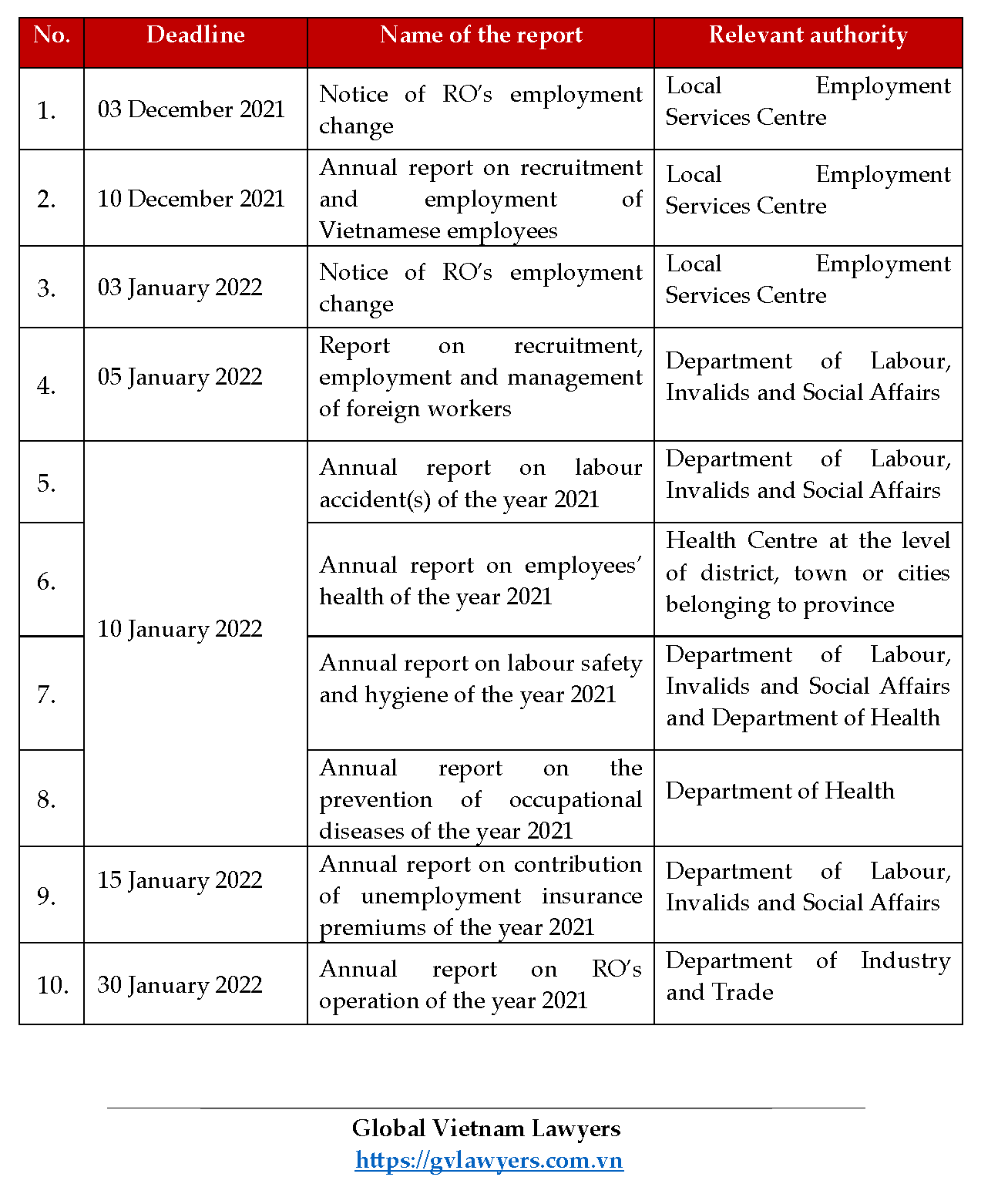
We are in the very last weeks of the calendar year 2021 and the year 2022 is coming. After an unsecured year with the complicated impacts of the SARS CoV-2 (Covid 19) pandemic, this is the time when the Vietnamese Representative offices of foreign traders (“RO(s)”) can have time to pay due attention to compliance matters. The ROs shall also need to mind and get prepared for the other required reports to be submitted to some local competent State authorities as giving updates on their operation (hereinafter collectively referred to as the “Reports”).

For your reference and compliance purpose, we would like to indicate below the standard statutory reports which the ROs may need to submit:

It is important to note that failure of submission of late submission of the afore said Reports may result in various administrative fines to be imposed on the RO as the case may be, e.g. failure to submit Annual report on operation is subject to a fine of VND40,000,000 according to Articles 4.4 and 67.2(b) of Decree 98/2020/ND-CP dated 26 August 2020.

In addition to the Reports, we would like to also remind you to arrange the schedule for annual employee conference of this year and the following year (if you have 10 or more employees) as prescribed by law. Our experience shows that, Valued Clients should retain a Grassroots Democracy Regulations at the workplace (“Regulations”)that specifically stipulates the form of conference organization, content, participants, time, place, process, responsibility for organizing the implementation and form of disseminating results as facilitating a better organization of the employee conference.

We are more than happy to assist Valued Clients in preparing/ submitting the required Reports and the Regulations where required upon your request.

***

We hope that you will find GV Lawyers’ Legal Alert useful and timely, enabling you to capture important and necessary information for your reference. Should you be further interested in or need legal advice related to Decree 41 and other current legal regulations, please contact us at info@gvlawyers.com.vn or by phone at 028 3622 355, we will assist and advise you on these matters as quickly as practicable.

Rate this post

The post Legal Alert| December 2021 appeared first on Global Vietnam Lawyers.


source https://gvlawyers.com.vn/legal-alert-december-2021/

Legal Newsletter | May 2023

Dear Valued Customers and Partners, GV Lawyers would like to introduce you to Legal Newsletter Issue No. 05 of May 2023 . This newslette...